More multiple blocks

29 March 2011

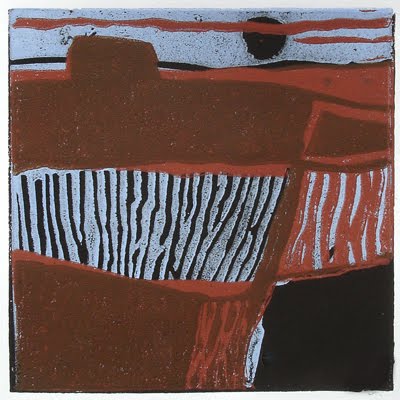
Another, more abstract, image based on Ashdown Forest, realised as a three-block linocut.


The first block is the paler pink (it's actually burnt sienna with lots of white); the second block is the darker pink; and the third block is the black. The "black" it actually black with quite a lot burnt sienna added: pure black is too cold and hard on its own.

Then I tried printing the blocks on coloured paper. The yellow makes the image much warmer.


I liked this, so I experimented a bit more. This time, I used another square of uncut lino to print a plain black background, and then printed the blocks in a different colours:


And then in completely different colours...

Multiple blocks, multiple colours

27 March 2011

The good things about making linocuts with multiple blocks is that you can try multiple colours...


Pink...


and purple...


and green...


and brown...


and yellow.

Then all you have to do is decide which one you like best.

Multiple block linocut: Forest moon

26 March 2011

I've been trying multiple block linocuts; never got them to work satisfactorily before, but that's no reason for not trying again.

This one is printed from three blocks. I cut this block first:


I transferred this block onto the other two blocks, and then cut those. The first block has just the moon cut out.


The second block has some distant hills and a track between the trees.


Then I printed all three blocks together.


Forest moon. Linocut, 10 x 7 cm.

Happy sheep

25 March 2011

Happy sheep!
I've got those hap-hap-happy sheep!
Give them a low-down bleat
And they begin dancing!


Acrylic on canvas, 15 x 15 cm.

Getting somewhere with collagraph

23 March 2011

Another collagraphed landscape, and I'm at last getting somewhere that I want to be.


Approx A4.

Except it isn't really collagraph: there wasn't any sticking. It's printed from strips of foamboard, which has two useful features: the smooth surface makes it easier to print flat even colours; and when you bend it, it creases, breaking up the surface and creating unpredictable textures.

More collagraph landscape

21 March 2011

This is another landscape, made from string and card and tape and paper, printed in white and black inks onto brown kraft paper, and then the sun stencilled on.


Approx A4.

Perhaps collagraph is starting make sense now.

Collagraphed landscape

19 March 2011

Still fighting to get collagraph to "work". I managed to stick enough paper and string and card and foil and even leaves to a couple of backing boards to make a landscape.

I experimented with printing the first board in white ink onto coloured paper, the second board in black, and then stencilling a circle for the sun.


It's difficult to get enough ink onto the uneven surface of the collagraph plate; you can see how the density increases with successive prints, but it's possible to have some control over this with careful burnishing.


All: Collagraph on paper, A5.

Printmaking class: Starting with linocut

17 March 2011

This week at the printmaking class, I introduced the principles of linocutting. Starting with some sample blocks to explore the tools and marks that they can make...


... we moved onto cutting our first images in lino. These are proofs of the first stage; there's more work to be done in the next session.

Louise


Jennifer


Carol


Kat


More information about the printmaking class.

Tractor collagraph

15 March 2011

Struggling with collagraph. At last, I managed to make this image by printing individual textures separately.

Tractor collagraph
Tractor, A3

For example, the furrows of the ploughed field are printed from corrugated card; the clouds with a kitchen sponge; and the trees with, appropriately, leaves.

Experimenting with collagraph

13 March 2011

I tried collagraph: printing from found textures. You stick stuff onto a board, and then print from it. It's a lot more difficult than it sounds.

I printed an owl.


Paper owl. Collagraph, A3.

The printing plate is made from paper, kitchen towel, tin foil, corrugated card, kraft paper... anything I could find. The interesting thing about collagraph is that makes you see things differently: anything with a texture you pick up and think, "I could ink that".

But I'm yet to be convinced that all the work involved is worth it.